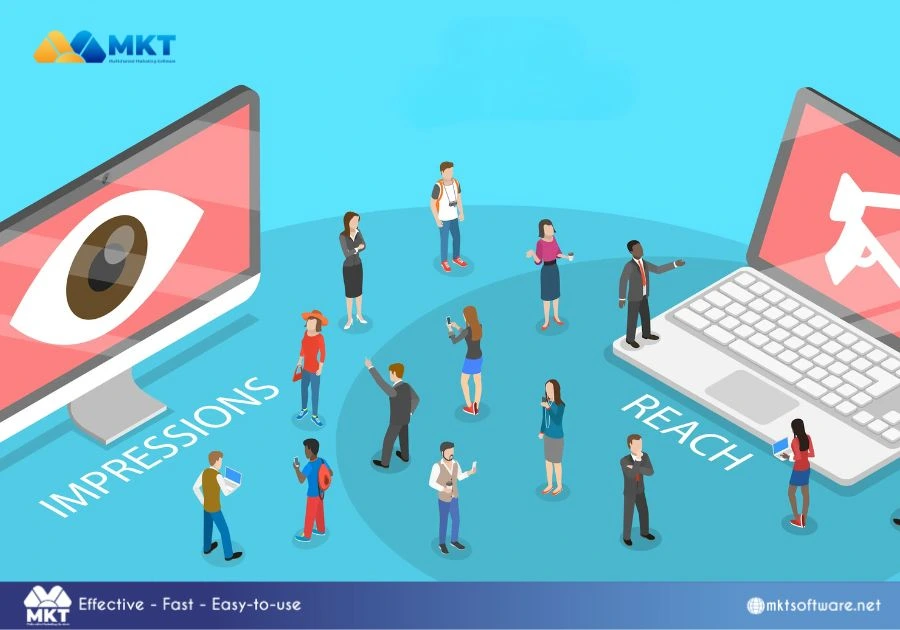
Understanding what each LinkedIn posts’ metrics are is the first step to successfully building a professional network there. Among them, one of the most common points of confusion is the difference between impressions and views. Many users assume these metrics are interchangeable, but in reality, they represent very different aspects of how content performs on LinkedIn. In this article, MKT Software will answer the burning question: Are impressions the same as views on LinkedIn?
The short answer is No, impressions and views are not the same on LinkedIn. An impression refers to the number of times your post appears on someone’s LinkedIn feed, regardless of whether they interact with it. A view, on the other hand, typically requires a deeper level of interaction, such as watching a video for a certain duration or opening content intentionally.This distinction is critical. A post can receive thousands of impressions but only a small number of views if users scroll past it without engaging. On the other hand, a post with fewer impressions but higher views may indicate stronger relevance to the audience it reaches.Are impressions the same as views on LinkedIn
What are post impressions on LinkedIn?
Post impressions on LinkedIn represent the total number of times a post appears on users’ screens. This includes impressions generated through:
Home feed placement.
Search results.
Profile activity.
Reshares by other users.
Company page feeds.
It’s important to note that impressions are not unique users. One person can generate multiple impressions if they see the same post more than once – which often creates misleading metrics results.Are impressions the same as views on LinkedIn – What are impressions?
Why impressions are important on LinkedIn
Impressions help LinkedIn evaluate how widely content is distributed. The platform’s algorithm uses impression data alongside engagement signals to decide whether a post should be shown to a broader audience, maintained at its current reach or will it be gradually deprioritized.It is important to note that impressions alone do not determine success. LinkedIn also looks at how users behave after seeing the post, such as pausing, clicking, reacting, or commenting, to assess content relevance. The algorithm then combines all of these metrics to form an overall performance assessment, which directly influences how long and how widely the post continues to be distributed.
Difference between views and impressions on LinkedIn
To understand LinkedIn analytics properly, it’s important to look at impressions and views as complementary instead of competing metrics.Impressions count how often your content is shown. Every time your post appears in a user’s feed, that counts as one impression, even if the user scrolls past without stopping.On the other hand, views reflect more meaningful interactions. For example:
A video view is counted only after a user watches the video for a minimum duration.
A profile view occurs when someone opens your profile.
A document or carousel view requires the user to click or interact.
Because impressions require no active engagement, they are always higher than views. This does not mean your content is underperforming, it simply reflects how LinkedIn measures reach versus engagement.Are impressions the same as views on LinkedIn – Impressions vs Views
Implications for content optimization
From a performance perspective, a post that receives high impressions but low views indicates strong distribution but weak engagement. This suggests that while the algorithm is showing the content widely, the post itself needs optimization, such as clearer messaging, stronger hooks,… to better resonate with viewers, not just the algorithm.Conversely, a post with lower impressions but a high number of views signals highly targeted distribution. In this case, LinkedIn is showing the post to a smaller but more relevant audience, resulting in stronger engagement and a higher likelihood of sustained reach compared to broad, untargeted exposure.Understanding this balance helps content creators identify whether they need to improve visibility, content quality, or audience targeting.
Tips to improve impressions on LinkedIn
Improving impressions on LinkedIn requires optimization in content quality and a deep understanding of algorithmic behaviors. Below are some practical strategies to increase LinkedIn post visibility:
Create strong opening hooks
Strong opening hooks are critical to LinkedIn post performance because they directly influence whether users stop scrolling or move past your content. The LinkedIn feed moves quickly, and the algorithm closely monitors early user behavior. If users pause to read or expand a post, it sends a positive signal that the content is relevant.An effective opening hook should clearly communicate value immediately. This can be achieved by presenting a concise insight, a surprising observation, or a professional challenge your audience relates to. You should avoid vague introductions or generic greetings, as these tend to reduce attention and dwell time. In 2026, LinkedIn favors posts that demonstrate clarity and intent from the start, making strong opening hooks one of the most impactful ways to increase impressions and engagement.Are impressions the same as views on LinkedIn – A strong opening hook is important
Focus on generating meaningful engagement
Meaningful engagement plays a central role in how LinkedIn evaluates content quality. While reactions such as likes are easy to obtain, they carry less weight than comments that demonstrate thought, reflection, or discussion. The algorithm prioritizes posts that generate conversations rather than passive interactions.Some methods to prompt active engagement for viewers include:
Share experience-based insights.
Discuss practical takeaways or frameworks.
Create open-ended statements.
Utilize CTAs.
Actively engage with comments or shares.
Consistent update schedule
Consistency is a key factor in long-term LinkedIn visibility. Regular posting helps the algorithm understand your content focus and audience relevance, allowing it to distribute posts more accurately over time. Meanwhile, abnormal and infrequent posting can disrupt these signals, making it harder for LinkedIn to identify your content’s target audience.A consistent schedule does not require daily posting. Instead, you only need to maintain a predictable rhythm to help establish reliability and audience familiarity. In 2026, LinkedIn favors creators who contribute steadily to the platform, as consistency signals ongoing value rather than short-term activity spikes.Are impressions the same as views on LinkedIn – Have a consistent schedule
High readability in posts
Readability directly affects dwell time, which is one of LinkedIn’s most important behavioral signals. Posts that are easy to scan and understand encourage users to pause, read, and potentially interact. Poor formatting, long paragraphs, or dense blocks of text increase the likelihood that users scroll past quickly.High readability can be achieved through:
Short and concise paragraphs.
Logical spacing.
Clear sentence structure.
Utilizing bullet points.
Utilizing emojis.
Each line should aim to help deliver the message to the viewer as frictionless as possible, therefore you should avoid using unnecessary filler or industry-based jargons. Readable posts are especially important for mobile users, who make up a large portion of LinkedIn’s audience.See also: How does LinkedIn algorithm work? 2026 Update
For more knowledge-sharing posts, visit our YouTube Channel!