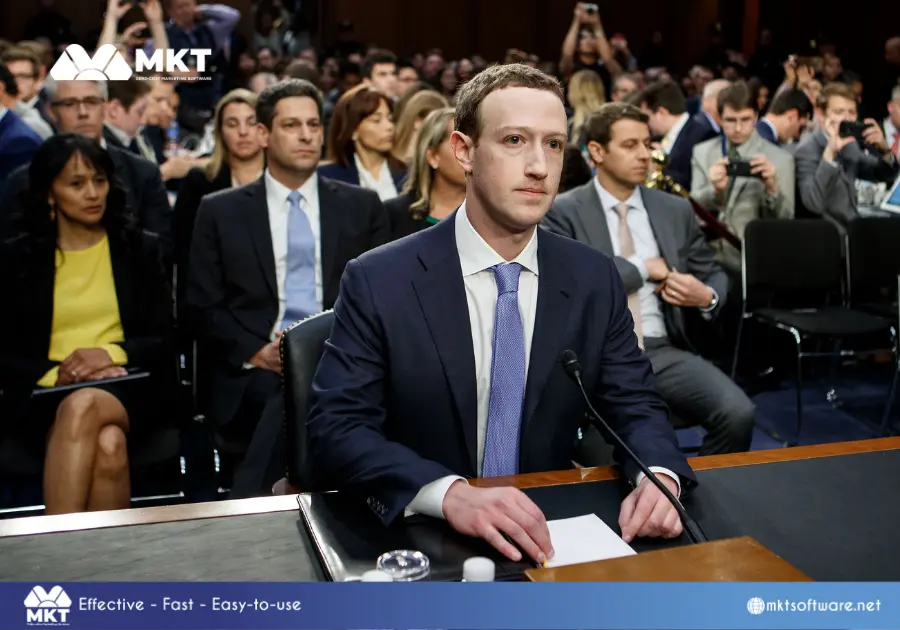
Over the past two decades, Facebook has continuously transformed, shifting from a simple social network into a complex online ecosystem into the giant social media platform we know today. It’s hard to believe that this remarkable journey, filled with both challenges and milestones, also began on what seemed like just another ordinary day.In this article, MKT Software will answer the question: When was Facebook created? and explore the evolution from its earliest days to its current global influence.
To put it simply, Facebook was officially launched on February 4, 2004, under the name “TheFacebook” by Mark Zuckerbergand his co-founders at Harvard University. Initially designed as a platform for college students to connect and share information, it quickly expanded beyond its original scope due to tapping into human’s desire for connections.Within its first year, the company quickly formalized its structure and began scaling rapidly. By 2005, it had acquired the domain “facebook.com” and dropped the “The” from its name – marking the beginning of Facebook’s official transition into a more established platform.However, this was only the beginning. Over the next two decades, Facebook grew rapidly, evolving into a dominant force that reshaped the social media landscape.Facebook was launched on 2004 by Mark Zuckerberg and his fellow students
II. The complete timeline of Facebook
Facebook didn’t reach its current standing overnight. Instead, it’s the result of 20 years filled with ups and downs, continuous innovation, and bold strategic decisions that ultimately defined its success.
2.1. The early days (2004 – 2010)
In its earliest phase, Facebook was initially restricted to Harvard students before gradually expanding to other universities. The most significant turning point came in 2006, when Facebook went public and opened registration to anyone aged 13 and above with a valid email address.This transition marked a shift from a closed academic network to a global social platform, dramatically accelerating Facebook user growth and international adoption.Facebook went public in 2006
Introduction of Core Features
During this period, Facebook introduced several foundational features that would shape its long-term usability and engagement model, such as the launch of News Feed in 2006 which centralized content consumption by aggregating updates from friends into a single stream.The introduction of photo sharing and tagging significantly enhanced user interaction by allowing people to connect through visual content. In 2009, the iconic Like button was introduced, helping to simplify engagement into a single action while also providing Facebook with valuable behavioral data.In 2009, Facebook’s iconic Like icon was created
Early Monetization and Scaling
As Facebook’s user base expanded, the company began experimenting with monetization. Early advertising models were introduced, including targeted ads that leveraged user data. One notable example was Facebook Beacon in 2007, which attempted to integrate external user activity into advertising but was ultimately shut down due to privacy backlash.
2.2. The ecosystem building era (2010 – 2015)
Between 2010 and 2015, Facebook transitioned from a social networking site into a broader platform. The introduction of Facebook Pages allowed businesses and public figures to build an official presence, transforming Facebook into a key marketing and communication channel.The introduction of Facebook Pages allowed brands and public figures to build an official presence
Major acquisitions
The acquisition of Instagram in 2012 strengthened Facebook presence in mobile and visual content, while WhatsApp acquisition in 2014 helped expand its reach in global messaging. These acquisitions were not isolated decisions but part of a broader strategy to dominate various areas of digital interaction.
Mobile-First Transformation
As user behavior shifted toward smartphones, Facebook adapted by prioritizing mobile experiences. The company restructured its products around mobile usage, leading to the development of standalone applications such as Messenger in 2011.
2.3. Algorithm-driven and content-centric era (2015 – 2020)
During this phase, Facebook’s News Feed evolved into a highly sophisticated algorithmic system, more commonly known as Facebook algorithms today. Instead of displaying content only based on chronological order, the platform began prioritizing posts based on relevance, engagement, and user behavior data.Machine learning models were then introduced to analyze post signals to back up the algorithms. This addition led to a major change in how brands and content creators approach content creation.
Rise of Video and New Content Formats
Facebook placed significant emphasis on video content, recognizing its growing importance in digital consumption. As such, they rapidly introduced features such as Facebook Live, to enable real-time interaction, while native video uploads get prioritized in the News Feed.Despite its growth, this period was also marked by significant challenges. The Cambridge Analytica scandal in 2018 exposed issues related to data privacy and user trust, leading to widespread criticism and regulatory scrutiny.The Cambridge Analytica scandal in 2018 exposed Facebook’s data security issues
2.4. Meta era and platform transformation (2020 – today)
In 2021, Facebook, Inc. rebranded as Meta Platforms, Inc., signaling a shift in strategic direction. The company positioned itself as a leader in building the metaverse, focusing on immersive digital environments powered by virtual and augmented reality.This rebranding represented a broader vision that extended beyond social media, aiming to redefine how users interact in digital spaces.However, at the beginning of 2026, Zuckerberg announced a strategic shift away from AR and VR technologies, signaling a move away from the company’s metaverse focus in favor of generative AI development.Meta is stepping away from metaverse development
AI-Driven Recommendations
Artificial intelligence now plays a central role in Facebook’s content distribution. The platform has moved toward a discovery-based model, where users are shown content not only from their connections but also from accounts and creators they may not follow.This shift reduces reliance on the traditional social graph and emphasizes relevance and engagement as primary ranking factors.
III. Key milestones of Facebook history timeline
Facebook’s evolution is best understood through a series of key milestones that reflect not only product development, but also its major shifts in strategy and development. These milestones highlight how Facebook transitioned from a university project into a global digital ecosystem under Meta:
2004: Launch of TheFacebook.
2005: Domain acquisition and rebranding to Facebook.
2006: Public access and introduction of News Feed.
2009: Launch of the Like button.
2012: IPO and acquisition of Instagram.
2014: Acquisition of WhatsApp.
2018: Cambridge Analytica scandal.
2021: Rebranding to Meta Platforms, Inc.
2022 – today: Expansion into AI, VR, and integrated ecosystem development.
IV. Final thoughts
What began as a university networking site has, through years of challenges and transformation, grown into a central component of the global digital ecosystem. By understanding Facebook’s journey, businesses and marketers can gain valuable insights into how to maintain relevance in an increasingly complex digital landscape.